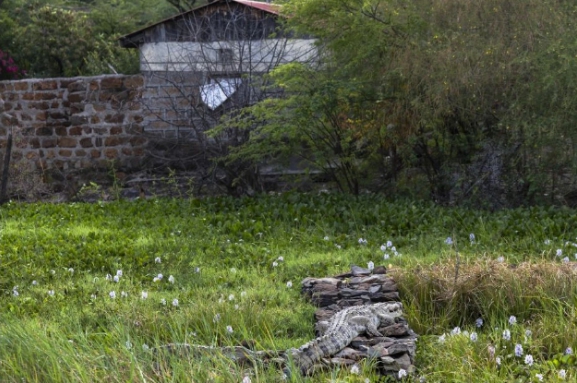
A crocodile lies stretched across the sun-warmed roof of a submerged conference hall, its tail hanging over where a projector screen once was.
For tourists it looks surreal. For families along Lake Baringo’s shore, it is proof the water is winning.
Over the last two years, Kenya’s Rift Valley lakes have risen to unprecedented levels. At Lake Baringo, the flood has swallowed entire villages, three health centres, 10 schools, and several tourist lodges. The resort’s conference hall — once booked for weddings and meetings — now sits half underwater. Its roof has become basking ground for crocodiles pushed inland.
The Science: Why The Lakes Won’t Go Back
This is Kenya’s other climate crisis. Not drought, but drowning.A 2024 study in the Journal of Hydrology found that lake surface areas across East Africa expanded by more than 71,800 square kilometers between 2011 and 2023. NASA satellite images comparing 2010 and 2026 show Lake Baringo and nearby Lake Naivasha spreading far beyond old shorelines.
Scientists blame a mix of heavy rainfall linked to climate change, deforestation in catchment areas, and poor drainage. The result: lakes that have doubled in size in a decade.
The human cost was already documented before the latest rains. A 2021 Ministry of Environment and UNDP study found more than 75,000 households across the Rift Valley had been displaced. At Baringo, the water came fast. Farmer Dickson Ngome near Lake Naivasha said he woke up in late 2025 to find his home “inside the lake. The water came from nowhere”.
Wildlife In Living Rooms
As the shoreline moves, wildlife follows. Crocodiles and hippos, once confined to the lake, are now regular visitors to what was dry land. In Baringo villages, residents report crocodiles crawling through streets and “napping outside people’s front doors”.
For children, school is now dangerous. “Pupils who come from a distance have to use canoes to reach their schools, so they are prone to crocodile attacks,” said teacher Rehema Lewer. Her Salabani Primary was forced to move under an acacia tree after the lake took the classrooms.
The tragedy is personal. Winnie Keben of Kampi ya Samaki was washing her legs in the lake after farming when a crocodile pulled her under. Fishermen say they have survived multiple attacks working the new shoreline. One woman lost her only two goats to a crocodile.
An Economy Under Water
Lake Baringo’s economy was built on water. Birding, boat rides, hippos, crocodiles. Lodges like Tumbili Cliff marketed sunrise views and wildlife trips.
That business model is now submerged. Most hotels along the shores of Baringo, Bogoria and Lake 94 “have disappeared into the rising waters occasioning huge losses to the industry”. A conference facility at Soy Lodge is among tourist sites closed by the disaster.
The peak season in August — when flamingos migrate from Lake Natron — is now a season of losses. Roads, parks and access routes have been cut off.
Baringo Governor Benjamin Cheboi says the county’s disaster-response unit lacks funding. “We need more money to help rebuild what has been lost, and to provide food and clothing to victims,” he said.
The Big Question
Kenya planned for drought for decades. Few planned for permanent lakes.If the water does not recede, what happens to the displaced households? Who compensates farmers whose land is now two kilometers under water? Who is liable when a crocodile attacks in what used to be a school compound?
Experts warn this is not cyclical flooding. It is a structural shift. The lakes are not expected to return to 2010 boundaries anytime soon.
For now, the crocodile basks. Below it, chairs are still stacked for a conference that will never happen. Outside, families pack what’s left and move to higher ground.The lake took the building. It may be coming for the town next.
#ClimateCrisis #LakeBaringo #RisingLakes #KenyaWildlife #Displacement